My friend Boris Smus wrote a piece today on “platform fertility”:
Unless iPads become more hackable or other, more developer-friendly tablets emerge as serious competitors, laptop computers will become specialized tools for software professionals while tablets supplant laptops for the rest of the public.
Even if iPads do become more hackable or developer-friendly tablets become more popular, I suspect PCs are well on their way to becoming a specialized tool.
The problem is exacerbated when you set out to try to invent the next thing. How do you interface with your new stereo camera rig? How many hurdles do you have to overcome to make it possible to interface with your new smart watch? How about a pair of smart contact lenses? How do you get raw USB access? … This is generally where you climb down a layer of abstraction - for example, to NDK in Android. Without such an option, you’re left dead in the water.
This is Boris’ warning about closed platforms: they cannot spawn new platforms.
Closed devices may be dead ends in terms of what you use to program the next device, but not in terms of product evolution. Bright engineers have used open computers to make gaming consoles increasingly awesome ever since they evolved from the personal computer decades ago. Consoles became their own species, and innovation continues unhindered.
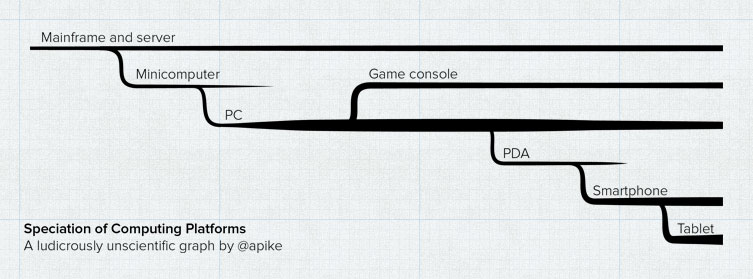
As the market matures, computing devices are specializing. Curated, focused experiences are delivering a better product for certain types of computing, while not effectively addressing other types of computing. Personal computers - the trucks to tablets’ cars and game consoles’ motorcycles - will live on and be used to build yet more platforms1. Software developers, office workers, and professional creatives still need hackable, flexible, and powerful systems.
As such, I’m happy to use an open computer to create awesome software, and a closed tablet to check my email and surf the web. May the PC continue to spawn new species forevermore.
-
I may be wrong, and the next generation of developers might join Cydia’s creator Saurik in creating platforms with jailbroken iPhones or hacked Xboxes. In some ways, this would be kind of awesome. ↩